Manual vs Electric Grain Rollers for Home Use: Which Is Right for You?
If you're milling grain at home—whether for brewing, baking, or animal feed—a grain roller is essential kit. But the choice between manual and electric isn't straightforward. Both work, but they suit different workflows, budgets, and expectations. This guide cuts through the marketing to help you pick the right one.
Why the choice matters
A grain roller crushes grain to expose the starches and sugars without pulverising it to flour. It's different from a grain mill (which produces flour) and more precise than a hammer or mortar. Get the wrong tool, and you'll either spend half an hour hand-cranking a sack of barley or spend £300 on a machine that sits in the garage. Understanding the real differences saves both time and money.
How grain rollers work
Both manual and electric models use a pair of fluted or smooth rollers rotating against each other. The grain drops between them, gets crushed to the desired coarseness (usually adjustable), and falls into a collection tray. The rollers are spaced to produce consistent sizing—typically a crush rather than a grind, leaving the husk mostly intact.
The difference is what turns the rollers: your arms or a motor.
Manual grain rollers
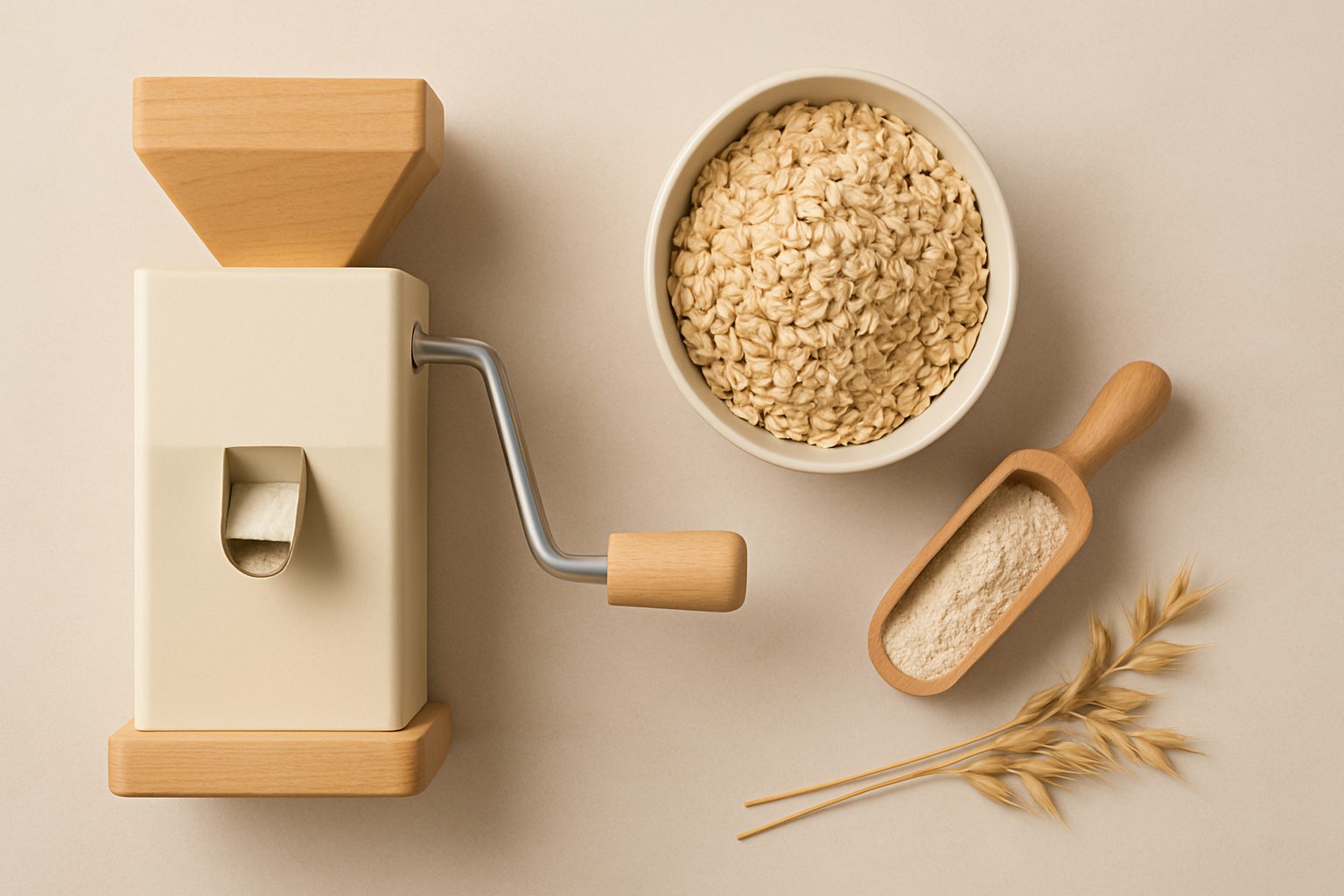
A manual roller has a handle that you crank, turning gears that drive the roller pair. You feed grain hopper-style and work the handle in a rhythmic motion. Most home models crush 1–2 kg of grain per 5–10 minutes of hand-cranking, depending on the coarseness setting and your effort level.
Build and durability: Manual rollers are mechanically simple—mostly cast iron or steel, no electrics to fail. They last years with minimal maintenance. The gear ratio matters: a 6:1 or 8:1 ratio makes hand-cranking less exhausting than a lower ratio. Cheap models (under £40) often have loose tolerances and less stable frames; mid-range models (£50–150) are worth the extra cost for stiffer construction and better gearing.
The hand-cramping truth: After 10–15 minutes of steady cranking, your forearm will fatigue. Your wrist gets a repetitive strain that some brewers and bakers find genuinely uncomfortable. If you mill grain multiple times a week, this matters.
Consistency: Manual rollers give you tactile feedback—you feel if the grain is feeding smoothly or jamming. This makes them forgiving if you adjust the roller gap while running. The downside: consistent crush depends on keeping a steady hand-crank speed, which is harder than it sounds.
Electric grain rollers
An electric roller has a motor (usually 120W–500W) driving the rollers. You load the hopper and press a switch. Most home models process 5–20 kg per hour, depending on power and coarseness.
Cost: Entry-level electric models start around £150–200. Mid-range (£300–600) offers better build, quieter operation, and faster throughput. High-end models (£800+) are overkill for home use.
The noise: Electric rollers aren't silent. Expect 70–85 dB—louder than a kitchen mixer, quieter than a power drill. It matters if you're milling early morning or in a shared space.
Hands-off convenience: Load and walk away. This is the real selling point. You can mill a 20 kg sack of grain in 20 minutes without strain. For anyone milling more than once a week, this saves real time and effort.
Feedback and control: Electric models are less forgiving. If you hit a jam or a foreign object, the motor keeps pushing rather than stopping naturally. Better models have jam-release handles or reverse-feed features. Cheaper ones can burn out a motor if overloaded.
Pros and cons at a glance
| Feature | Manual | Electric | |---------|--------|----------| | Cost | £30–150 | £150–800 | | Throughput | 1–2 kg per 5–10 min | 5–20 kg per hour | | Physical effort | High (hand-cramping for 10+ min) | None | | Noise | Quiet (hand-crank sound only) | 70–85 dB | | Reliability | Very high; simple mechanics | Good if mid-range or better | | Maintenance | Minimal; occasional cleaning | Motor brush wear (50+ hours) | | Footprint | Compact, portable | Larger; needs bench space | | Consistency | Good if hand speed steady | Excellent and repeatable | | Ease of adjustment | Mid-run adjustment easy | Requires stop-adjust-restart | | Best for | Occasional use, tight budget | Regular use, convenience priority |
Which should you choose?
Pick a manual roller if:
- You're budgeting under £100
- You mill grain fewer than twice a month
- Your space is cramped or silent operation matters
- You like mechanical simplicity and no moving parts to wear out
- You don't mind a bit of hand work
Pick an electric roller if:
- You mill regularly (more than twice a month)
- You process sacks larger than 10 kg at a time
- You want the grain ready without standing over it
- You're willing to spend £200–400 on mid-range quality
- You prefer repeatable, uniform crush every time
If you're at the borderline—say, milling once every two weeks—cost usually decides it. A decent manual costs a third of a decent electric. But if you're doing this year-round, the electric's hands-off operation and speed earn back the extra cost within a year.
Final word
Neither choice is wrong. Manual rollers are trusty, durable, and cheap—perfect for budgeters and occasional millers. Electric rollers trade cost and space for convenience and consistency. Choose based on how often you'll use it, how much grain you process per session, and whether your forearms care about survival.
More options
- Electric Home Grain Flaker / Roller (Amazon UK)
- Manual Grain Roller for Home Use (Amazon UK)
- KitchenAid / Stand Mixer Grain Roller Attachment (Amazon UK)
- Eschenfelder Grain Flaker (Amazon UK)
- Whole Grain Oats & Wheat Berries (consumable upsell) (Amazon UK)